Extension vs. Torsion Garage Door Springs: Which Should You Buy?
Every sectional garage door is balanced by springs — the opener only guides it. There are two systems: extension springs, a pair that stretch along the horizontal tracks, and a torsion spring, a single wound spring on a shaft above the opening. Both work. Torsion costs a little more and is what we recommend for almost every home; here is why, and when extension is the right call.
Spring broken? Call 201-621-2161Hardware boxes: Extension $295 · Torsion $325
Side by side
Which one should I buy?
Choose torsion if…
You have the headroom (most attached garages do), you want the quietest and most balanced door, you're installing a heavier insulated or windowed door, or you plan to add a wall-mount opener like the LiftMaster 98032, which mounts to the torsion shaft and needs it.
Choose extension if…
Headroom is under about 10″ and you'd rather not use a low-headroom torsion conversion, you're replacing a door that already runs on extension springs and the track layout is fine, or you're keeping the budget to the minimum. Always install the safety cables.
What's in the box
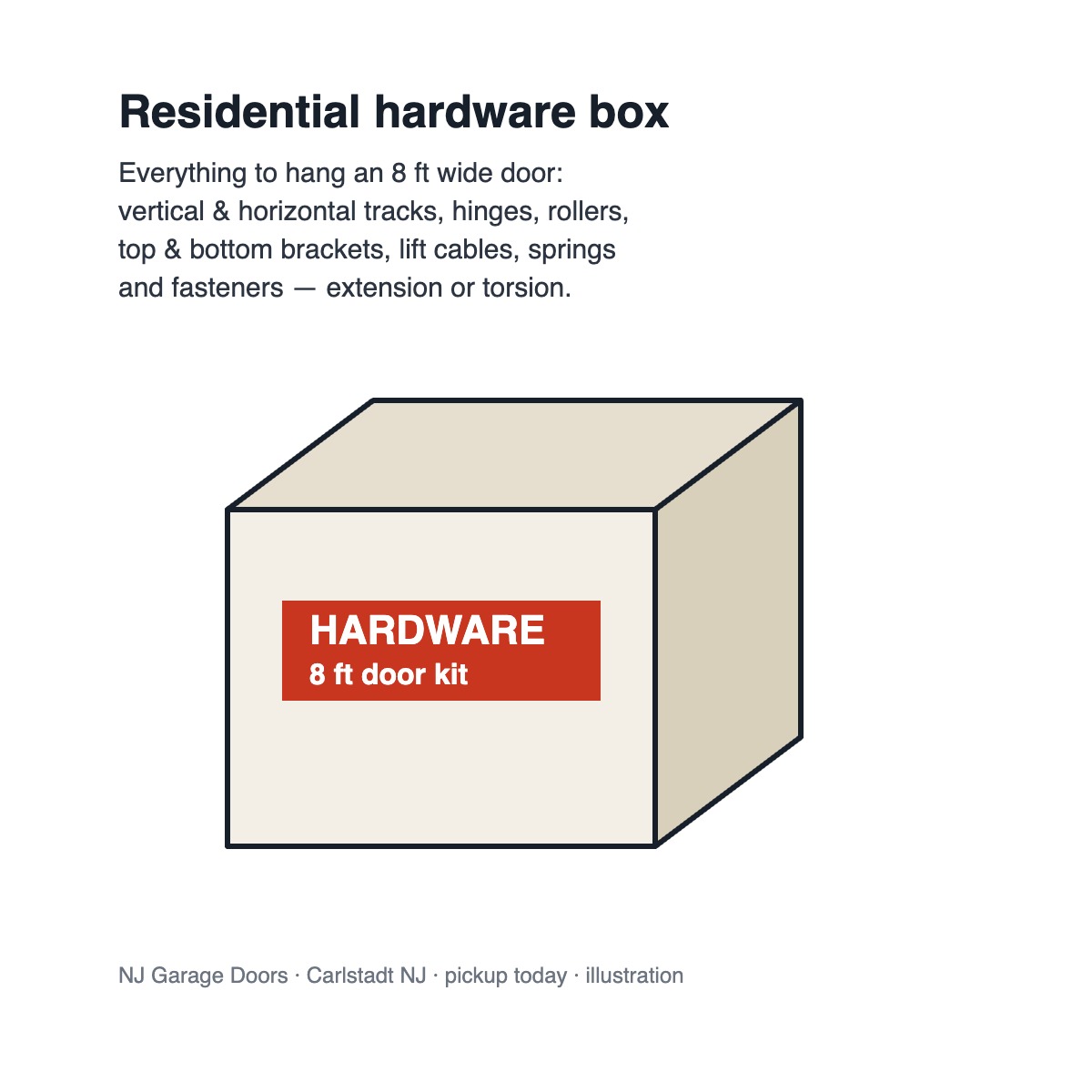
Every C.H.I. door we stock comes with extension springs, tracks, hinges, rollers, struts and bottom seal. Upgrading a stocked door to a torsion spring is $39 — pick it on the product page. If you're re-hanging an existing door, the residential hardware box has all the track and hardware for an 8-ft door, in an extension version ($295) or torsion version ($325).
Replacing a broken spring
A door that won't lift, an opener that strains and stops, or a loud bang from the garage usually means a broken spring. Don't try to open the door with the opener — the motor is not built to lift the full weight. Spring replacement is a same-day repair across North Jersey, and we replace both springs on a two-spring door so they wear evenly. Torsion springs are under high tension and need winding bars; we don't recommend DIY on them.
Spring questions
Can I switch my door from extension to torsion?
Yes, if you have about 12″ of headroom. It's a common upgrade when we replace springs, and it makes the door run smoother. Ask for a quote when you call.
How long do garage door springs last?
Standard springs are rated for roughly 10,000 cycles. At four cycles a day that's about seven years; a busy family door goes faster. High-cycle torsion springs are available on request.
Should I replace both springs?
Yes. The second spring has the same cycles on it and usually breaks within months. We replace them as a pair.
Is a torsion spring door safer?
Generally yes. The spring stays contained on the shaft when it breaks, and the even lift reduces the chance of a door coming off its tracks. Extension springs are safe when the safety cables are installed.